

Iber
Making sustainability reflection part of student learning.
A service concept exploring how sustainability reflection could fit into NTNU students’ existing coursework, with an optional learning pathway for those who want to go further.
My role
Service design, UX research, prototyping
Context
NTNU • IDG3002 Service Design
Timeline
8 weeks • Spring 2024
Team
5 designers
Status
Service concept & prototype
The challenge
NTNU’s brief proposed a learning diary to encourage sustainability reflection. Our research raised a broader question: what would make students use it regularly, alongside their existing coursework?
Our response
Iber brings together required course activities and an optional learning pathway leading to a sustainability certificate. The concept combines opportunities to reflect, receive feedback, and explore sustainability beyond individual assignments.
My contribution
I contributed to research, service logic and user journeys, and low- and high-fidelity prototyping within the team.
Interest alone was not enough.
Interviews, desk research, and service mapping showed different levels of motivation, confidence, and available time. The service needed to work for students who wanted to explore sustainability and those focused on completing their required coursework.
Desk research
Student interviews
Affinity mapping
Personas
Service mapping
Students needed a reason to use a reflection diary, and voluntary activities could be easy to deprioritise.
Connect core activities to coursework and give optional learning a distinct purpose.
Preferences varied between individual and group work, and sustainability was often associated mainly with the environment.
Propose flexible submission formats and a learning pathway covering broader sustainability themes.
Course leaders already spent time evaluating student work.
Include their task-setting and feedback responsibilities in the service blueprint.
Actor map
Mapping the student’s wider context kept NTNU, peers and working life in view.
Original actor map • Norwegian

One service, two ways to participate.
We developed the diary brief into a service with two complementary parts: course activities to support regular reflection, and optional learning for students who wanted to go further.
Part of coursework • reviewed by course leaders
Required course activities
1
Course leaders set activities linked to their subjects.
2
Students submit reflections as text, audio or images.
3
Course leaders review submissions and give feedback.
4
Students can revise work that has not been approved.
Voluntary • marked automatically
Optional certificate pathway
1
Students choose sustainability topics, organised in levels.
2
Multiple-choice tasks are marked automatically.
3
Badges, a progress bar and a growing plant show completion.
4
Completing the pathway leads to the proposed certificate.
The distinction let us design for different levels of ambition without making all additional learning compulsory.
Accessibility considerations
The concept offers reflection through text, audio or images, giving students different ways to participate. Each format would need accessible support, including transcripts for audio and text alternatives for meaningful images, and testing should check whether time, language or format still keeps some students from taking part.
Making the two pathways clear.
Required work and further learning, at a glance.
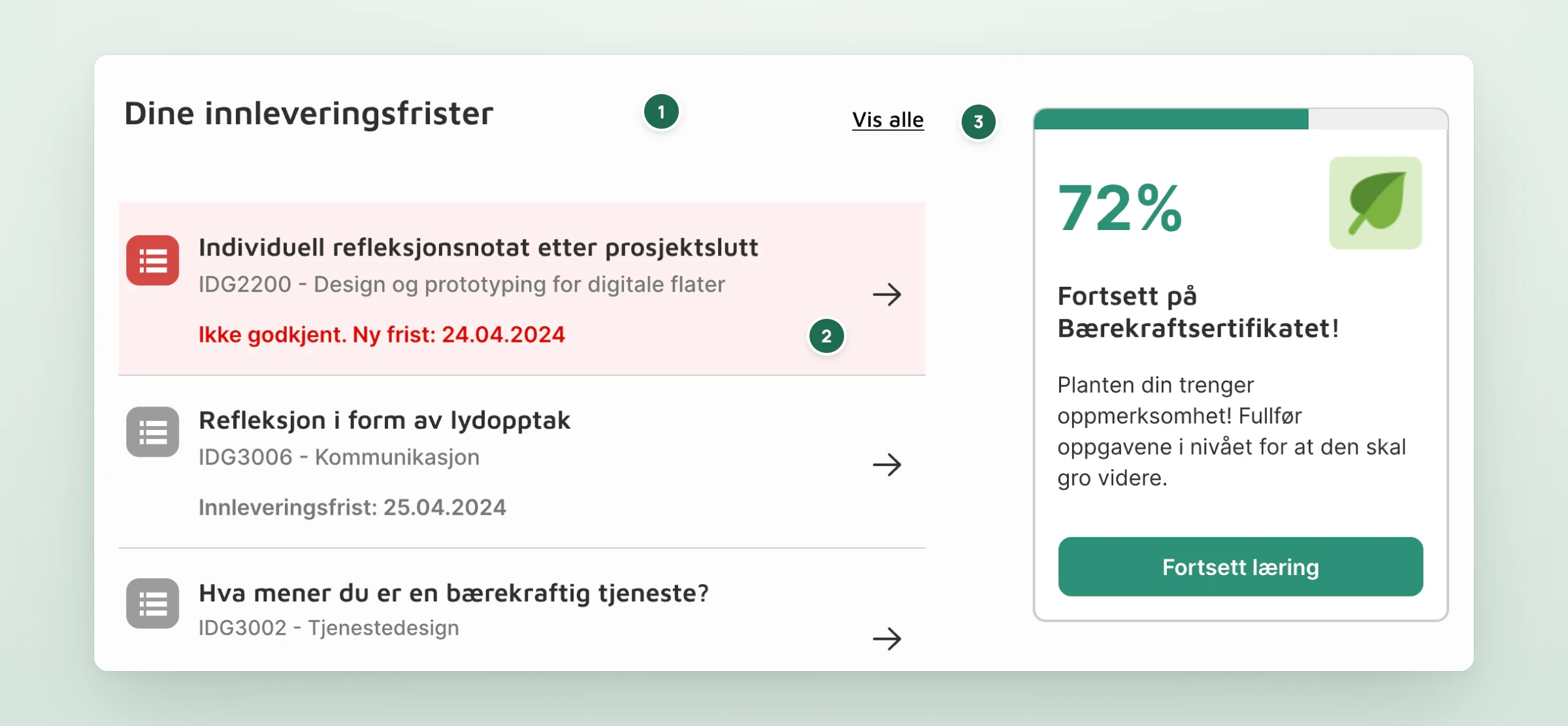
The dashboard lists course deadlines and submission status, with its own route back into the optional certificate pathway.
1
Course activities and deadlines
Each submission is listed by due date, with its subject.
2
An unapproved submission
It stays at the top of the list, with its new deadline.
3
Progress in the optional pathway
This card leads back to the certificate pathway; the 72% is sample content.
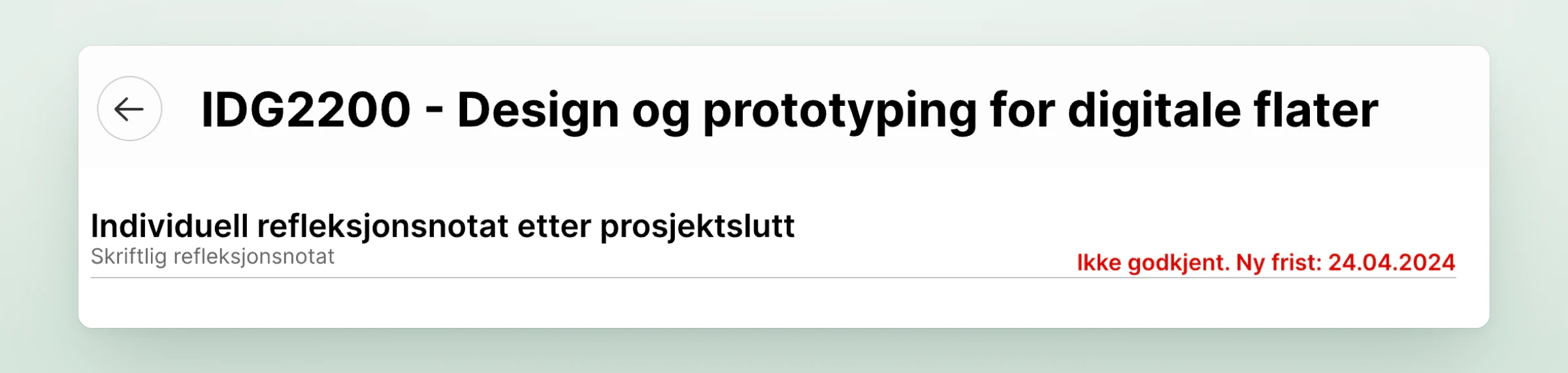
A submission marked “not approved” shows a new deadline for revision.
Make further learning visible
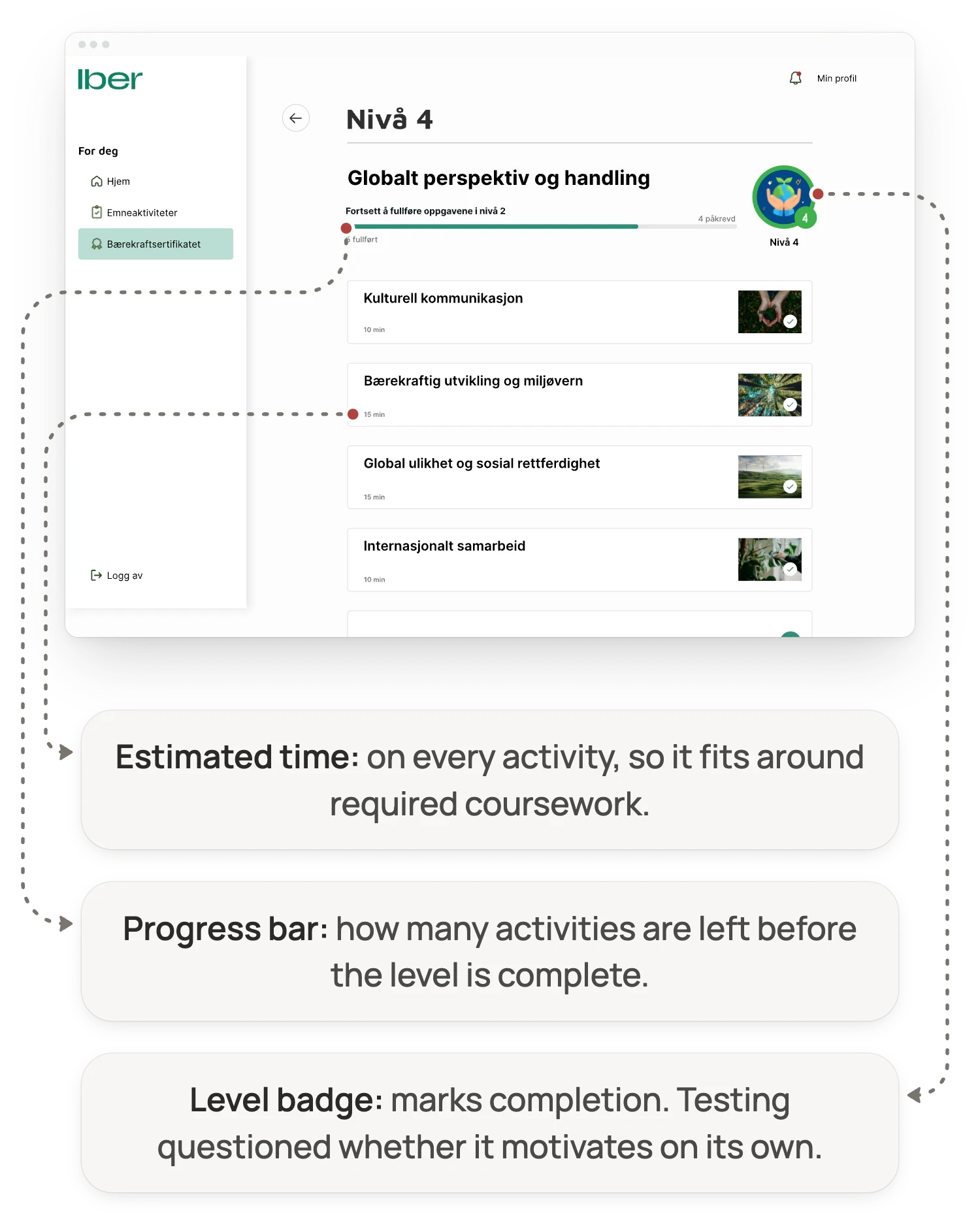
The optional pathway organises sustainability topics into levels. Completion markers, estimated activity times, and progress feedback are intended to make the next step easier to understand.
Level 4, “Globalt perspektiv og handling” (Global perspective and action). Prototype in Norwegian.

Give optional learning a tangible outcome
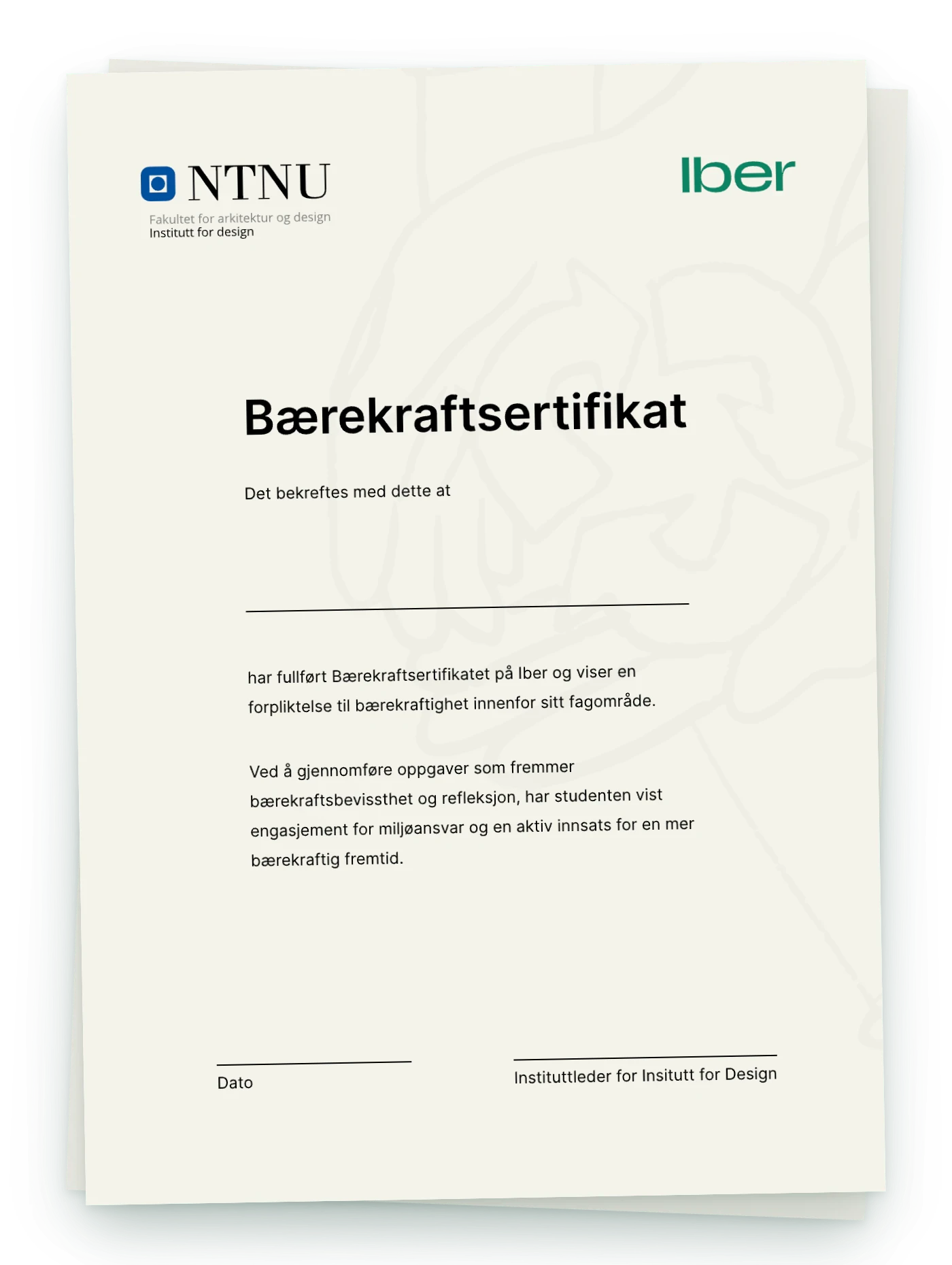
Testing raised doubts about the value of voluntary activities and badges. The final proposal gave the pathway a more tangible outcome: a sustainability certificate intended to communicate additional learning beyond university.
Proposed sustainability certificate. Its educational and professional value would need further validation.
What testing changed.
We tested a low-fidelity prototype with students and grouped their feedback to identify changes. The findings concerned both usability and the reasons students would choose to participate.
Students questioned the value of the voluntary pathway and its badge.
The final proposal emphasised a certificate with a purpose beyond the course.
Students struggled to find assessments and wanted clearer completion feedback.
The final proposal made submission status and activity completion visible.
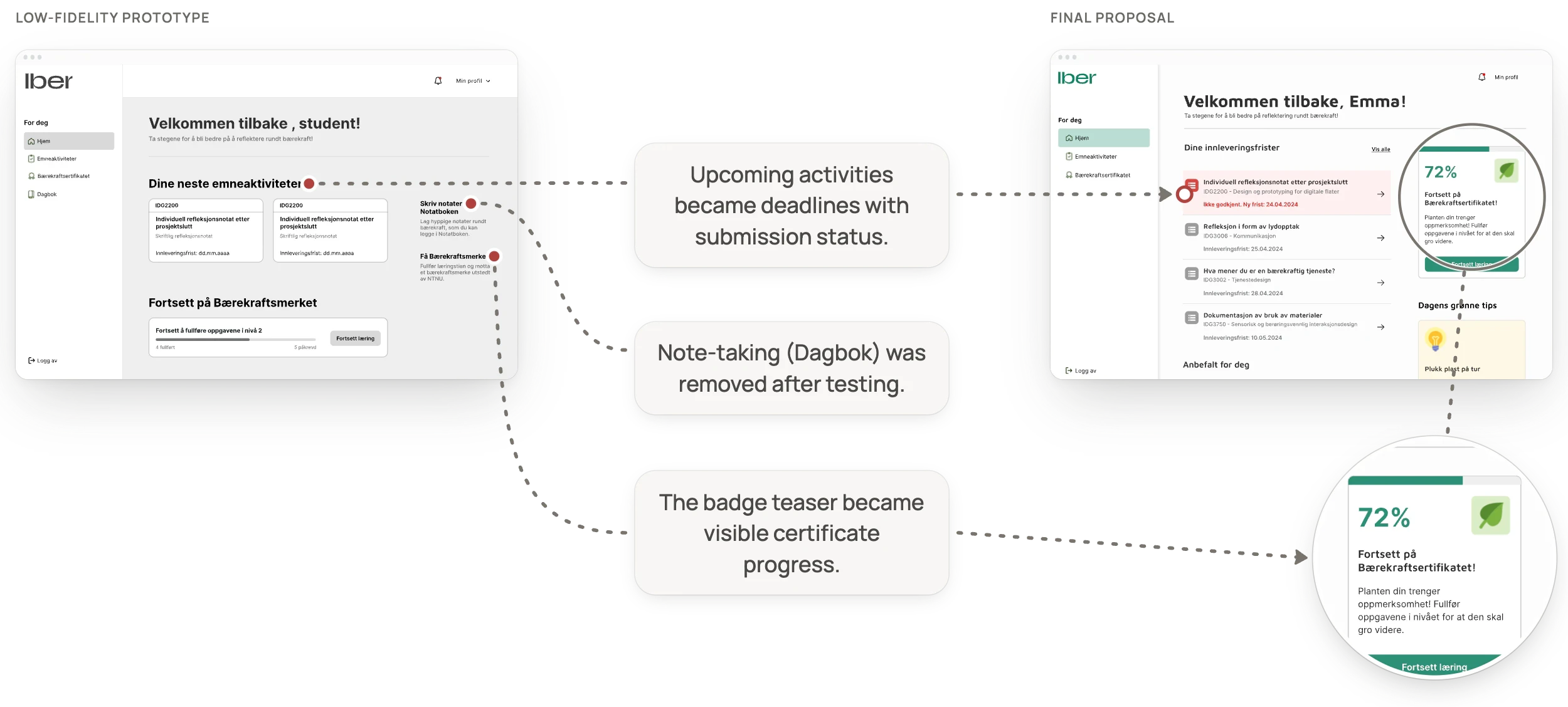
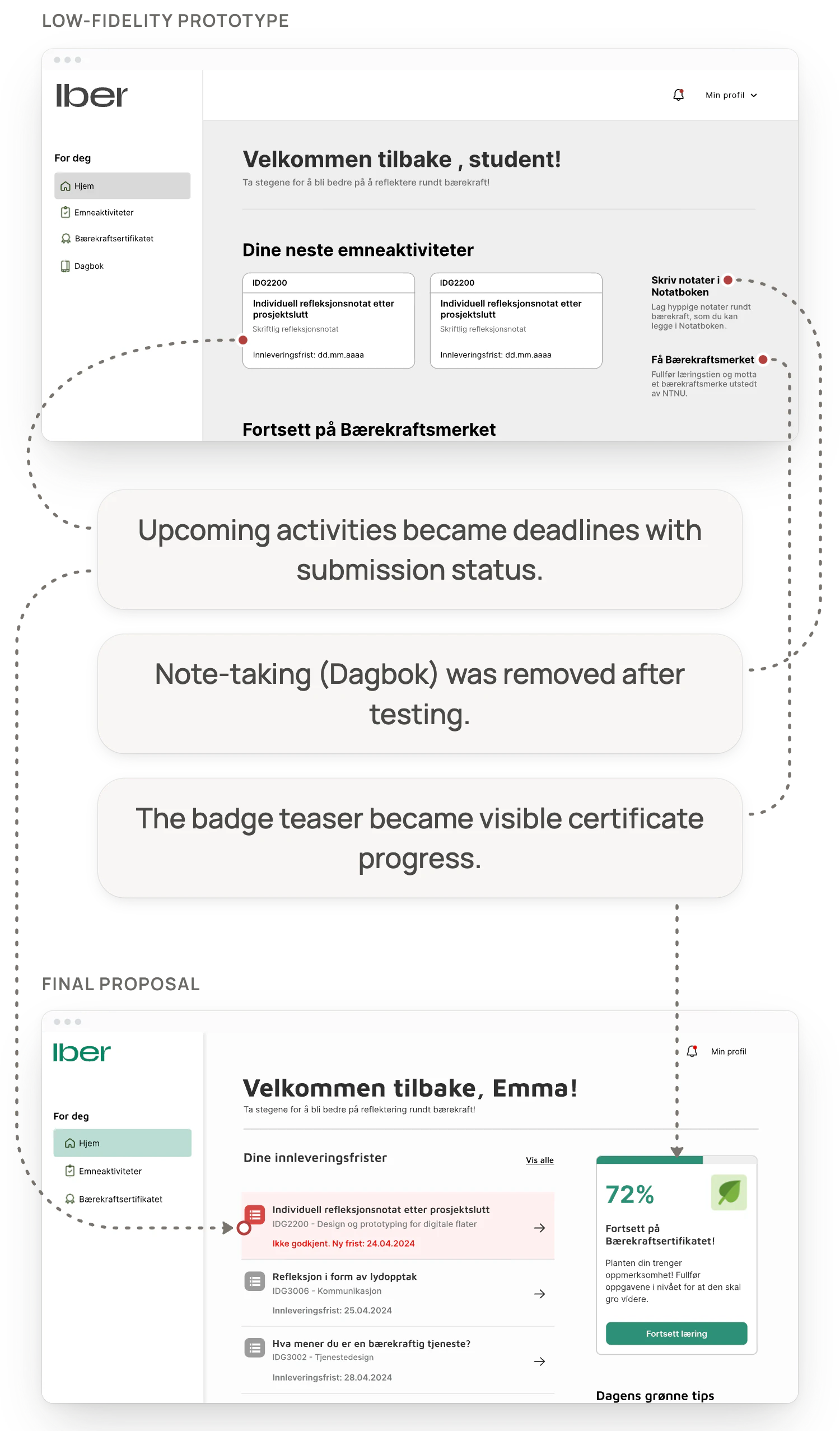
We removed note-taking after testing raised questions about its purpose. The final proposal focused on course activities and the optional learning pathway.
Low-fidelity testing informed the final proposal; the high-fidelity interface still needed user testing.
The service behind the interface.
The student interface was only one part of Iber. Our service blueprint connected student actions with course leaders’ responsibilities for setting activities, reviewing submissions, and giving feedback, alongside the proposed platform support for the certificate pathway.
Simplified summary of the proposed service, based on our blueprint
Student
Submits reflections as text, audio, or images, and revises work that is not approved.
Chooses topics and completes level-based activities, with automatic feedback.
Course leader
Sets activities linked to the subject, reviews submissions, and gives feedback.
No marking role. Automated marking and certificate generation were proposed; setup and ongoing maintenance still needed to be explored.
Platform support
Login through the university and a system for creating and assessing activities.
Automatic marking of tasks and automatic issuing of the certificate from a template.
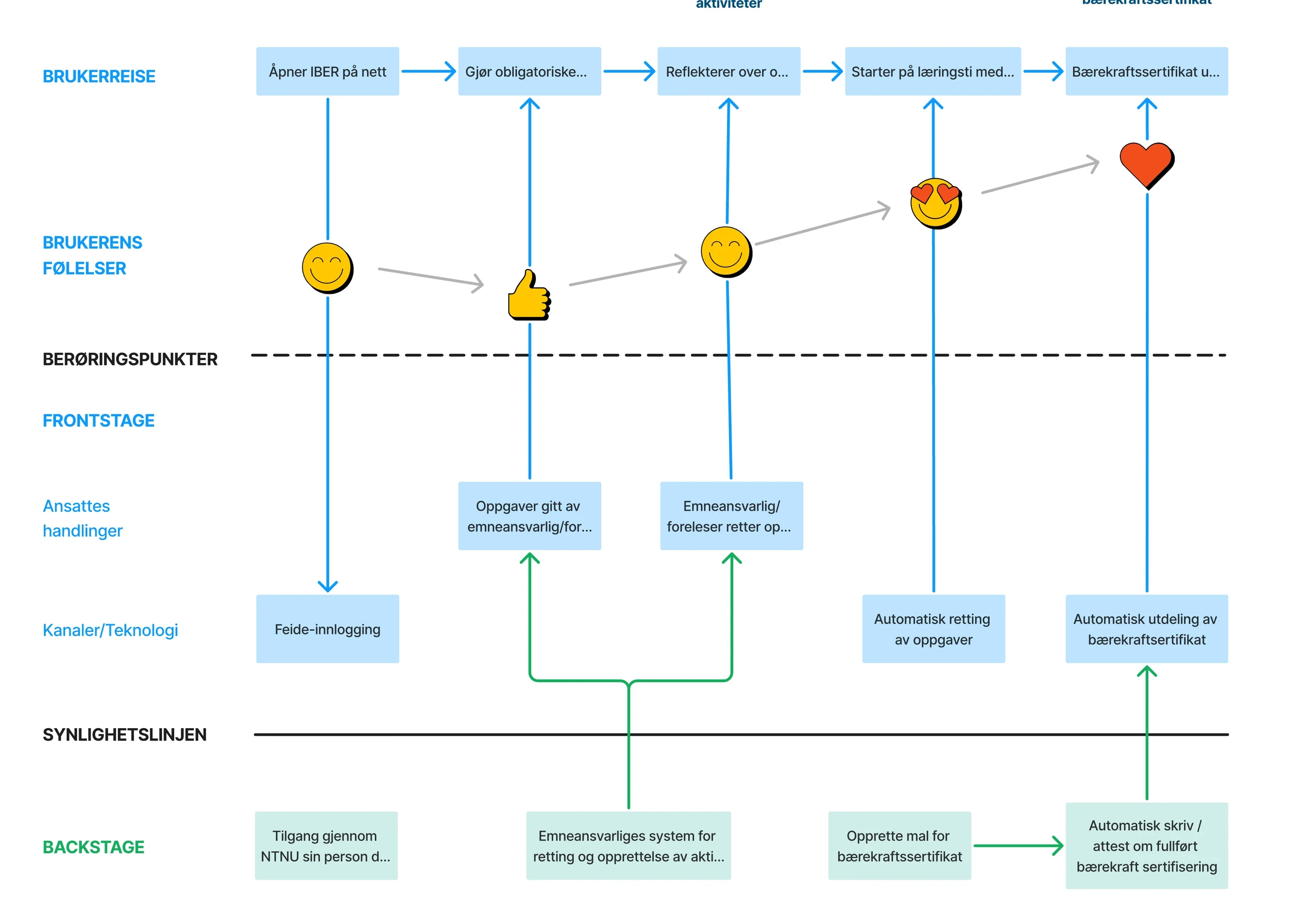
Mapped, not prototyped
The course-leader interface was mapped but not prototyped. Stakeholder feedback raised a practical question: would the service support their work or add another system to maintain?
Design trade-off
We proposed a standalone platform partly because our research at the time identified uncertainty about NTNU’s learning platform. That gave Iber independence, but left the risk of duplicated work unresolved.
A service proposal with questions still open.
The project produced a student-facing prototype, service blueprints, and a scenario-based walkthrough connecting the student experience with the work behind it. Stakeholder feedback valued the walkthrough and the attention to value after graduation, while asking for clearer links between research and design decisions.


The student-facing prototype: the home page with deadlines and pathway progress, and the sustainability certificate the pathway leads to.
Reflection
The key question is whether visible progress supports meaningful learning. Badges and a certificate risk rewarding completion rather than reflection: a finished pathway shows participation, but not the quality of a student’s reflection or their ability to apply sustainability in practice.
Next steps
1
Test the full student experience
Check whether people can locate feedback, understand progress, and see a reason to return over time.
2
Prototype the faculty workflow
Examine task creation, assessment, and workload with course leaders, including the cost of using another platform.
3
Define the learning and assessment model
Develop the pathway content and criteria for evaluating reflection, then test what the certificate can credibly represent.
Any further development would also need to decide whether Iber belongs inside NTNU’s existing learning platform, rather than adding another system for course leaders to maintain.
Credits
Team: Asma Al-Sahli, Jenny Ngo Luong, Sondre Skytteren, Emil David Brendbakken and Mathias Johansen • Supervisor: Mari Bjerck • NTNU IDG3002 Service Design, 4th semester, spring 2024
Read next

